A Sense of Place: Gormleys Belfast
Past exhibition
Overview

Gormleys Belfast presents a group exhibition bringing together six distinctive voices in Irish landscape painting: Martin Mooney, Liam O’Neill, James Brohan, Sallyann Beirne, Hannah Mooney and Eugene Conway.
Although each artist has developed a highly individual style, they are united by a shared fascination with place. Together, their work offers a vision of Ireland that goes beyond the familiar postcard view: an Ireland of changing weather and shifting light, working landscapes, rural communities, memories and everyday life.
What connects these artists is not a particular style or geography, but the way they look at Ireland. For each artist, landscape is more than something to be represented. It is something experienced and felt.
Born in Belfast and now based in rural Donegal, Martin Mooney brings a deeply observed yet richly atmospheric approach to the Irish landscape. His paintings of Connemara, Donegal, Belfast Lough and the west coast combine careful observation with expressive colour, capturing the drama of skies, the character of the land and the particular quality of Irish light. His work demonstrates how familiar places can continually reveal something new when looked at closely.
Liam O’Neill brings the human story of County Kerry to the heart of his work. A native Irish speaker from Corca Dhuibhne in West Kerry, O’Neill paints the landscape alongside the people, traditions and daily activities that give it its identity. Fishermen, horse fairs, turf cutting, boats, musicians and the distinctive landscape of the Dingle Peninsula become part of a vivid record of a place and its community. His work is rooted in a way of life passed between generations, giving his paintings an immediacy as well as a strong sense of cultural memory.
James Brohan approaches Ireland through colour, movement and atmosphere. His paintings encompass boats, harbours, farm animals, gardens and rural life, capturing moments that feel both spontaneous and deeply familiar. Influenced by the Irish Impressionist tradition, Brohan is less concerned with rigid description than with conveying the mood and energy of a place, and the emotion contained within an ordinary moment.
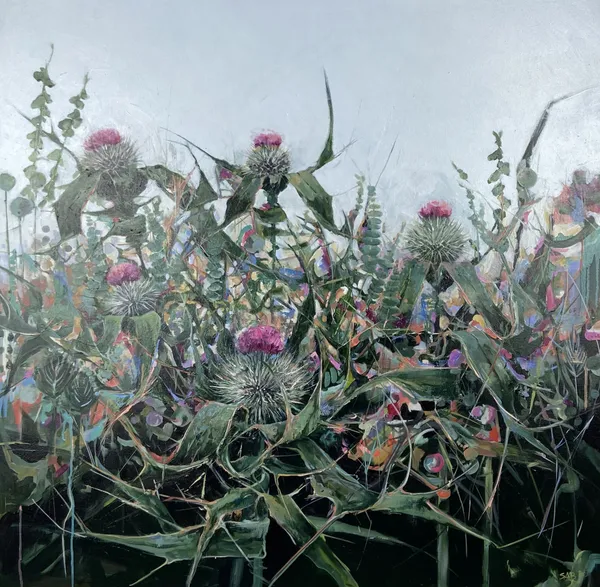
For Sallyann Beirne, the landscape becomes a living, constantly evolving environment. Working from her base in the west of Ireland, she looks closely at hedgerows, grasses, thistles, saplings and roadside vegetation, the seemingly overlooked elements of the countryside. Her layered surfaces and rich textures reflect the complexity, resilience and passage of time within the natural world, inviting us to consider the extraordinary life contained within even the smallest corner of the Irish landscape.
Hannah Mooney, one of the younger voices in the exhibition, brings a contemporary sensitivity to the enduring subject of the Irish landscape. Based in County Mayo, her paintings draw on places including Clew Bay, Lough Mask, the Nephin mountain range and the rugged western coastline. Rather than simply depicting these locations, Mooney distils her experiences of weather, light, atmosphere and memory into expressive compositions. Her work captures the transient nature of the landscape, the feeling of a particular place at a particular moment, before the light changes and the experience becomes memory.
In Eugene Conway’s paintings, the quieter aspects of rural Ireland take centre stage. Bridges, barns, sheds, roads, walls and country lanes become subjects in their own right. His realist landscapes are attentive to the subtle changes brought about by weather, seasons and light, while also acknowledging the layers of history created by farming and habitation. Conway finds poetry not in grand spectacle, but in the overlooked details of ordinary rural life.
Together, Martin Mooney, James Brohan, Sallyann Beirne, Liam O’Neill, Hannah Mooney and Eugene Conway offer six different ways of seeing Ireland- six distinct voices, connected by an enduring sense of place.
They are about the places we know, the places we remember, and the places that change before our eyes. They celebrate the physical beauty of Ireland, but also its people, traditions, labour and quiet daily rituals. They recognise that the character of a place is found not only in its mountains, coastlines and fields, but in the turf being cut, the road home, the working harbour, the changing hedgerow and the fleeting light across a familiar landscape.
Works
-
 Mannin Bay, Connemara StudyMartin Mooney
 -
Dog's BayMartin Mooney
-
Grey's Point Belfast LoughMartin Mooney
-
Near Clifden StudyMartin Mooney


-
Dog's Bay II, ConnemaraMartin Mooney
-
Gort an ÓrnaLiam O'Neill
-
Beirt sa GhortLiam O'Neill
-
The Garden PathJames Brohan


-
Autumn MorningEugene Conway
-
Green ShedEugene Conway
-
Country StoneEugene Conway
-
ScardauneHannah Mooney


-
Clew Bay Ebb and FlowHannah Mooney
-
Connemara HillsHannah Mooney
-
Ballyglass Co. MayoHannah Mooney
-
SeascapeHannah Mooney